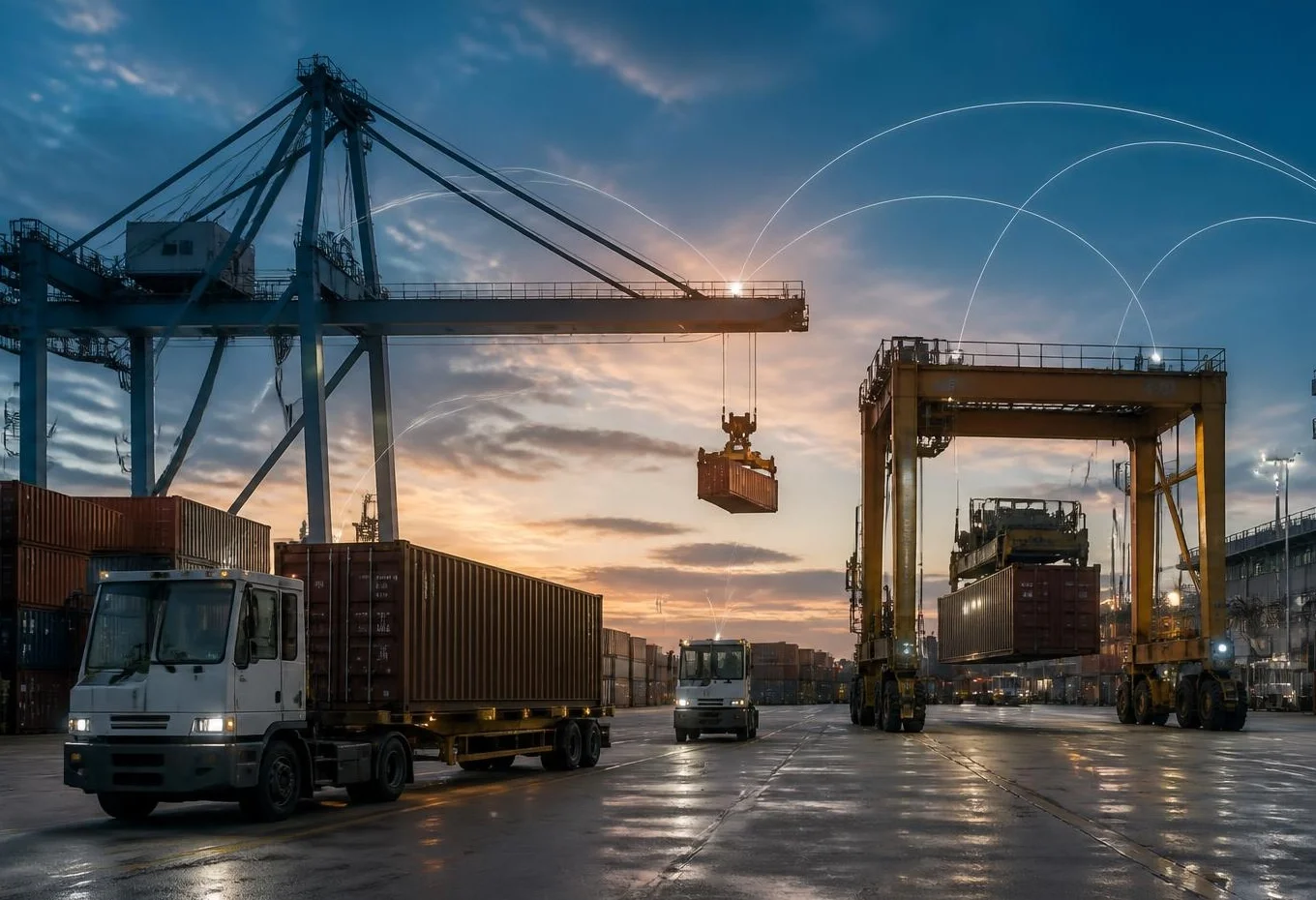
Port and terminal operations depend on mobile equipment that must remain connected while moving through large, complex, and often difficult wireless environments. Cranes, rubber-tired gantry cranes (RTGs), and terminal tractors (UTRs) carry onboard computers, PLCs, cameras, GPS devices, and other operational technology that needs dependable access to back-office systems.
The challenge is not simply getting a vehicle online. Operations teams need to know whether the equipment behind the vehicle gateway is reachable, performing adequately, and following the organization’s security policies. An S-CONE ruggedized wireless edge gateway and its centralized Dashboard provide a practical way to connect, monitor, and manage those distributed networks at fleet scale.
Why Mobile Equipment Connectivity Is Different
Each piece of mobile equipment commonly has its own isolated onboard network. Those networks may include devices that use the same private IP address ranges as devices on other vehicles. That design can be workable locally, but it creates a challenge when dozens or hundreds of vehicles need to communicate with shared applications, servers, and internal resources.
Mobile equipment also moves between coverage areas, experiences changing radio conditions, and may rely on a mix of WiFi and private or public 5G/LTE service. A temporary loss of connectivity can slow troubleshooting, limit visibility, and complicate coordination between operations and IT teams.
An S-CONE presents each piece of equipment as a single managed connection while preserving the isolated network behind it. Equipment-mounted devices connect to an onboard switch, which connects to the gateway. The gateway then forwards and routes traffic over available wireless links to the customer’s core network. Where public cellular connectivity is used, IPsec tunneling helps protect traffic in transit.
Dual WiFi and Cellular Connectivity for Moving Assets
S-CONE is designed as a ruggedized wireless edge gateway for port operations and other environments where mobile equipment must stay connected. It supports dual WiFi and cellular connectivity, including private and public 5G/LTE options. Automatic failover can help maintain connectivity when one path becomes unavailable or no longer meets operational needs.
For a terminal, this means a crane, RTG, or UTR can use WiFi where coverage is available and transition to cellular connectivity as operating conditions change. Rather than treating every onboard device as an independently managed connection, teams can manage the vehicle network through one edge gateway.
- WiFi and cellular flexibility: Support connectivity strategies that use yard WiFi, private cellular, public cellular, or a combination of services.
- Automatic failover: Help reduce the operational impact of a degraded or unavailable wireless path.
- Secure remote connectivity: Use IPsec-secured tunneling for public links to protect communications between the equipment and the customer network.
- Network bridging and edge forwarding: Route traffic from isolated onboard networks to authorized internal systems without creating unnecessary address conflicts.
Monitor More Than the Gateway
A gateway being online does not necessarily mean the devices on the vehicle are working. A camera, GPS tracker, PLC, onboard computer, or sensor can fail while the gateway itself remains reachable. This is why downstream IP monitoring is central to meaningful fleet visibility.
The S-CONE Dashboard lets teams define the IP addresses behind each gateway that should be monitored. Teams can organize gateways with custom tags, such as terminal, yard zone, equipment type, operational group, or maintenance category. The platform then checks whether the selected downstream devices are reachable and tracks key measures including uptime, latency, and packet loss.
This approach helps teams answer more useful questions:
- Is the RTG gateway connected, and is the RTG’s onboard PLC reachable?
- Is a terminal tractor’s GPS device responding consistently?
- Is connectivity degrading in a specific yard area or across a group of vehicles?
- Are cameras or computers behind a gateway experiencing packet loss or unacceptable latency?
- Which equipment groups should be prioritized when a service issue affects operations?
By monitoring endpoints behind the wireless edge gateway, teams gain visibility into the actual equipment dependencies that support port operations—not only the connection at the network edge.
One Dashboard for Fleet Management
Managing mobile equipment across one terminal is demanding. Managing gateways across multiple terminals, yards, or operating groups can become even more difficult when teams depend on separate tools and manual checks. The S-CONE Dashboard centralizes fleet management in a secure web interface.
From a single location, authorized users can review live gateway status, WiFi and cellular signal quality, connectivity state, and system health indicators such as CPU, memory, disk utilization, and temperature. Historical charts can help teams identify patterns over time, including recurring signal issues, capacity constraints, or equipment that needs attention.
Centralization can support faster triage because operators and IT teams have a common view of the fleet. Instead of dispatching a technician simply to determine whether a gateway is online, teams can review current status, downstream reachability, and available diagnostics before deciding on the appropriate response.
Reduce Field Work With Secure Remote Access
Sending personnel to inspect equipment in the field can take time and may interrupt maintenance schedules. Secure remote access capabilities can make many common troubleshooting and management tasks more efficient.
The Dashboard provides web-based terminal access and remote command capabilities for authorized users. These features can help teams investigate a connectivity issue, validate configuration state, or perform routine management actions without requiring an immediate on-site visit. As with any remote-access capability, role-based permissions and auditability are important for maintaining operational control.
For organizations that need a broader managed operating model, managed services can complement internal IT and operational teams with monitoring, support, and structured technology management.
Apply Updates and Policies Consistently
Fleet scale introduces a configuration challenge: a fix applied to one unit does not help if similar units remain unpatched or misconfigured. The S-CONE Dashboard supports over-the-air software updates for individual gateways or larger groups. Staged rollouts, automatic rollback capabilities, and deployment logs can help teams take a more controlled approach to change management.
The platform can also push network rules, firewall policies, and access settings across the fleet. Automated detection and correction of configuration drift helps support consistent policy enforcement when devices are deployed across multiple locations and maintained by different teams.
These controls are especially relevant where mobile equipment bridges operational technology and enterprise networks. Consistent firewall policy enforcement can help limit exposure while allowing the necessary traffic between onboard systems and authorized back-office resources.
Use Performance Data to Support Better Decisions
Connectivity is not always a binary condition. A vehicle may be online but experiencing insufficient bandwidth, high latency, unstable signal quality, or packet loss that affects a critical application. S-CONE includes built-in bandwidth and connectivity testing, with alerts that can be set when service falls below defined thresholds.
Combined with real-time status and historical trend data, these tests can help teams distinguish between a device issue, an onboard network issue, a coverage issue, and a broader service problem. Over time, the resulting data can inform decisions about wireless coverage, cellular service design, maintenance priorities, and operational support processes.
Keep Infrastructure Data Under Your Control
For many port, terminal, and industrial organizations, infrastructure information is sensitive. The S-CONE Dashboard can be deployed on-premise behind the customer’s firewall, with encrypted communications. This model can help organizations retain control over gateway, network, and operational data while using a centralized fleet-management platform.
Enterprise security capabilities include role-based access controls, two-factor authentication, directory-service integration, and an audit trail of actions performed in the platform. These features support accountability and can help align gateway administration with established access-management practices.
A Practical Approach to S-CONE Monitoring
Effective S-CONE monitoring begins with identifying the mobile assets and downstream devices that matter most to operations. For each crane, RTG, or UTR, teams can define the onboard endpoints that should be reachable, group assets with meaningful tags, establish performance thresholds, and determine which users should have access to management functions.
From there, the Dashboard provides a consolidated view of connectivity, gateway health, downstream endpoint availability, and configuration compliance. The result is a more actionable monitoring model: teams can see whether the vehicle is connected, whether critical onboard systems are reachable, and whether wireless performance is sufficient for the work the equipment must perform.
Strategic Service Solutions helps organizations design resilient connectivity and security architectures for complex operational environments. Explore the S-CONE platform, review IT networking services, or contact our team to discuss a monitoring and connectivity approach for your mobile equipment fleet.